Preventive AC Maintenance Tips for Long-Lasting Performance
With long, hot summers, fine grit and sand, and moist air for the most of the year, an air conditioner in Dubai hardly ever gets a break. A dirty filter, a blocked exterior unit, or a drain that has stopped running are some of the ways that wear builds gradually and causes a midsummer meltdown.
You don’t need any particular equipment or training to perform the AC maintenance advice for Dubai houses in this guide. A season-by-season calendar, a clear list of tasks that belong to a professional, and a safe routine for filters, the drain, the outdoor unit, and daily settings are all included. The owner’s manual for your unit should always be consulted first; if there are any differences, refer to the manual.
Before you start: power off and know your unit type
Every task in this guide starts with the power off.
- Switch the AC off with the remote or wall controller.
- Cut the power at the source. Samsung’s cleaning guide tells you to turn off the circuit breaker or unplug the unit, and Daikin’s operation manual says to stop the unit and turn the breaker off before cleaning. In most Dubai homes that means the AC isolator switch near the unit or the AC breaker in your distribution board. If you can’t tell which breaker is which, ask your building maintenance team first.
- Keep water away from the unit’s electrics. Daikin’s manual warns against washing the air conditioner itself with water because of the risk of electric shock or fire. You wash removable parts, not the unit.
Next, identify your system type, because the filter sits in a different place on each:
- Wall-mounted split: the indoor unit is high on the wall, with the filters behind a front panel that lifts up.
- Ducted or concealed: the indoor unit is hidden in the ceiling and you see only grilles. The filter is usually behind the larger return-air grille, where air is drawn in, not behind the smaller supply grilles that blow cold air.
- Cassette: a square panel set into the ceiling that blows air in several directions. The filter is behind the central grille.
If reaching a ceiling grille means standing on a chair or an unsteady ladder, stop. That job needs a second person and a proper step ladder, or a technician.
Clean the air filters: the job that matters most
A dirty filter restricts airflow. LG’s support guidance notes that a polluted filter can degrade cooling and cause noise and condensation.
Manufacturers differ on timing. Daikin’s manual recommends cleaning the filters every two weeks, Mitsubishi Electric also says every two weeks, and ENERGY STAR suggests you inspect, clean or change filters monthly. At a minimum, look at the filter once a month and clean it as soon as you see a layer of dust.
Wall-mounted split units
- Turn off the power as described above.
- Open the front panel by lifting it from the sides until it holds open.
- Remove the mesh filters. Most slide down and out once you release a small tab. If your unit also has a thin specialty filter (deodorizing, photocatalytic or similar), take it out separately. LG notes that many functional filters cannot be washed with water, so check the manual for how to care for that part.
- Remove loose dust first with a vacuum’s brush attachment or a soft brush. Samsung warns against stiff wire brushes, abrasive pads, benzene or thinner.
- Rinse in lukewarm or cool water. Daikin and LG both set a limit of 40°C, so don’t use hot water. If the filter is greasy or very dirty, use a mild neutral detergent, as LG and Samsung allow, then rinse thoroughly.
- Dry it fully in the shade. Shake off the water and let the filter air-dry somewhere shaded and well ventilated. Samsung advises against direct sunlight, hair dryers or other heat sources, which can warp the frame.
- Refit and close. Slide the dry filter back in its original direction and make sure the front panel is securely closed before you restore power. Don’t run the AC with the filter out, because the filter is what keeps dust off the indoor coil.
While the panel is open, avoid touching the metal fins behind the filter. Daikin and Samsung both warn that these aluminum fins can cause injury.
Ducted and concealed units
- Turn off the power and open the return-air grille. It usually unclips or swings down on hinges.
- Take out the filter and vacuum or gently brush off the dust. Actron Air’s guidance says you can also rinse it gently with water, as long as it dries fully before going back in.
- Refit the filter and secure the grille. If it is a disposable or pleated type, replace it with one of the same size instead of washing it.
When dust is worse than usual
After a dust storm, or when there is construction nearby, check the filters within a few days instead of waiting for your usual date. Daikin’s Middle East team notes that in the UAE summer filters collect dust surprisingly quickly.
Check the condensate drain and drip tray
While it cools, your AC removes moisture from the air. That water collects in a tray inside the indoor unit and runs away through a drain pipe. ENERGY STAR notes that a clogged drain can cause water damage and affect indoor humidity.
Your part is to look, not to dismantle. Once a month, and before summer, check for:
- Water marks or stains on the wall or ceiling below the indoor unit
- Dripping indoors, from the unit’s casing or a ceiling grille
- A musty smell when the unit starts
- The drain outlet, if you can see it (often on a balcony or outside wall). Daikin’s manual says to check that water comes out of the drain hose smoothly while the unit is cooling. If no water appears, it may be leaking indoors; the manual’s advice is to stop the unit and call a service provider.
Don’t push wires, sticks or chemical tablets into the drain, and don’t remove the casing to reach the tray. Unless your manual describes a homeowner procedure, flushing and clearing the drain line is a technician’s job. If you notice smells, visible dirt on the vents or weak airflow, our guide to the signs it needs cleaning helps you decide whether a deeper clean is due.
Look after the outdoor unit
The outdoor unit releases the heat removed from your home, so it needs open air around it. Daikin’s manual says don’t block the air inlets or outlets, don’t place objects close to the unit, and don’t sit or put things on it. LG adds that obstacles near the outdoor unit can degrade cooling.
On a Dubai balcony or roof, that means:
- Clear the space around it. Move stored boxes, bicycles, plants and laundry racks away from the unit’s front and sides.
- Don’t box it in. A cover or screen placed tight against the unit can block its air inlets and outlets. If your building requires a screen, make sure air passes freely through it.
- Remove sand and leaves by hand. With the power off, sweep sand drifts, leaves and litter away from the base and grille. Daikin notes that debris can also attract small animals into the unit.
- Don’t pressure-wash or hose the fins. The thin metal fins bend easily, and Daikin warns against washing the air conditioner with water. Cleaning the condenser coil with water or chemicals is part of a professional service unless your manual describes a homeowner method.
- Check the stand and brackets. Daikin’s pre-season checklist asks you to confirm that the base, stand and fittings are not decayed or corroded. Rust or a leaning unit needs a technician.
Check the visible pipe insulation
The pipes between the indoor and outdoor units are wrapped in insulation, which can crack or wear away where it is exposed to sun. Look along the length you can see for cracked, missing or peeling sections. Don’t patch them with household tape; damaged insulation should be properly replaced. Our page on AC pipe insulation explains what that work involves.
Daily habits that reduce wear
How you run the AC affects how hard its parts work every day.
- Set a steady temperature. DEWA’s long-running campaign asks residents to set the AC to 24°C. Daikin’s Middle East guidance explains that a lower setting doesn’t cool the room faster; it only keeps the unit running longer. Pick a comfortable setting near 24°C and leave it there.
- Avoid switching it off and on in quick succession. Some units have a built-in restart delay. LG explains that its systems wait 3 minutes before restarting after being switched off, and the countdown starts again each time you press the button. Give the unit time instead of toggling it.
- Use a timer or a higher setting when you’re out. If your controller has a timer or schedule, use it rather than leaving the AC on all day in an empty home or switching it on and off repeatedly. Daikin suggests raising the setting to around 27°C when you leave for a few hours.
- Keep the cool air in and the airflow open. Close doors and windows, draw curtains during the hottest hours, and keep furniture and curtains away from the indoor unit and return grilles.
If your main concern is electricity costs rather than wear, our article on high DEWA bills covers the habits that push consumption up.
AC maintenance tips for Dubai’s seasons: a year-round checklist
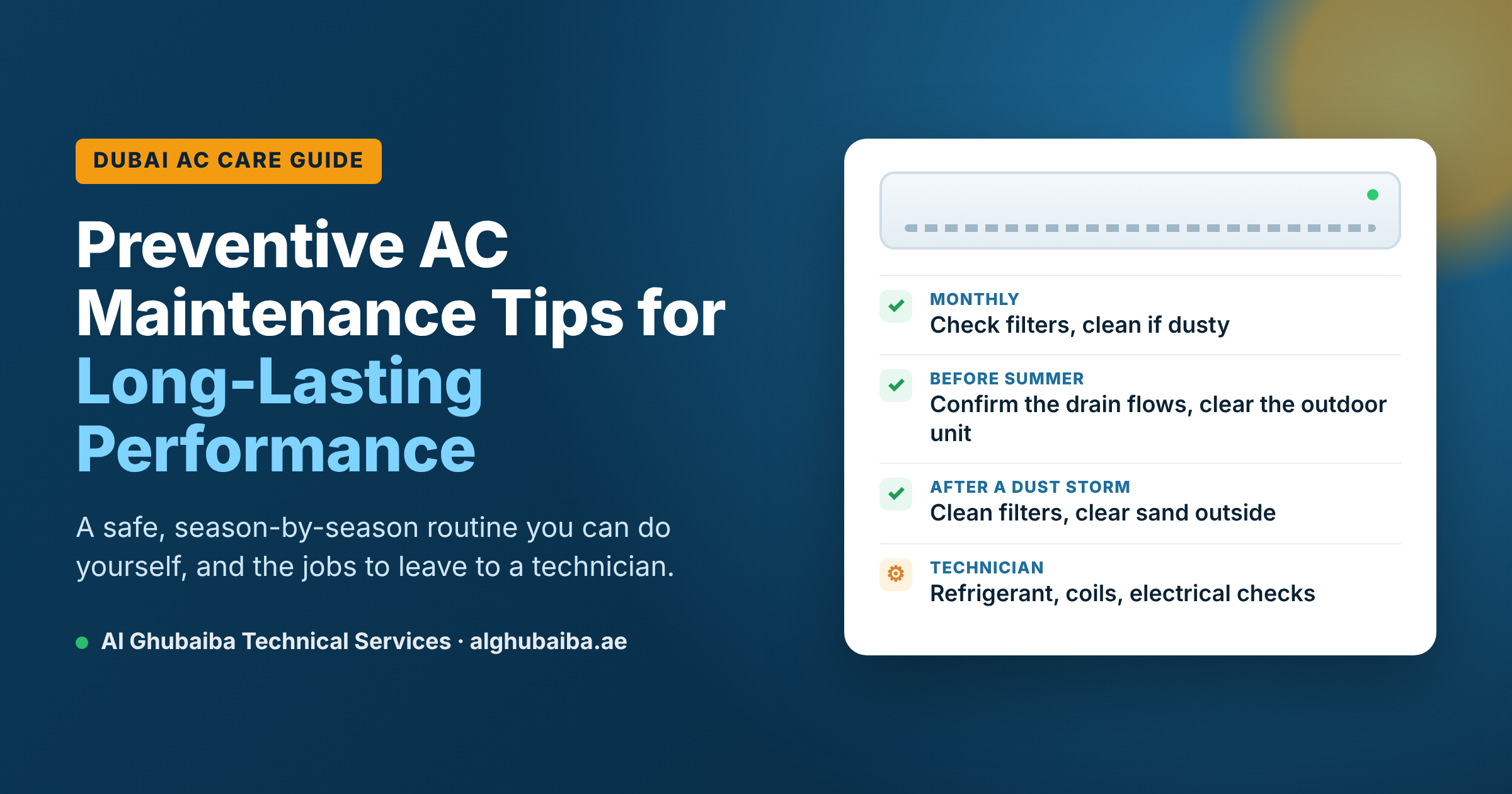
Use this table as your calendar. “You” tasks are the safe checks described above; “Technician” tasks are covered in the next section.
| Task | How often / when | Who |
|---|---|---|
| Check filters; clean if dusty | Monthly (or as your manual says); more often in peak summer | You |
| Clean every filter, including ducted return grilles | Before summer and after summer | You |
| Clean filters and clear sand from the outdoor unit | Within a few days of a dust storm or nearby construction | You |
| Look for water marks, drips or musty smells | Monthly | You |
| Run the unit in cooling mode and confirm water flows from the drain outlet | Before summer | You |
| Clear space around the outdoor unit; check stand and pipe insulation | Monthly glance; full check before summer | You |
| Run on fan only to dry the inside, then switch off the breaker | Before leaving a unit unused for weeks | You |
| Refrigerant, coil cleaning, drain flushing, electrical checks | At each professional service | Technician |
| Duct cleaning (ducted systems) | When a technician advises it | Technician |
The fan-only step comes from Daikin’s manual, which suggests running the fan for several hours on a fine day before a long idle period. How often your system needs a professional service depends on the system and how you use it; our guide to AC service frequency covers that question. During peak summer, also watch for weaker cooling, new noises or water where it shouldn’t be; our list of AC breakdown warning signs explains what each can mean.
Jobs to leave to a technician
Some maintenance needs training, tools or licensing, and doing it yourself can be dangerous or damage the unit:
- Refrigerant (gas) checks and top-ups. ENERGY STAR notes that both too much and too little refrigerant reduce efficiency and shorten equipment life. Measuring and handling refrigerant takes specialist equipment.
- Chemical coil cleaning. Daikin’s manual recommends specialist maintenance, because the inside of a unit can get dirty after several seasons of use and lose performance.
- Duct cleaning for ducted and concealed systems. If you’re not sure which your system needs, our explainer on coil vs duct cleaning sets out the difference.
- Electrical parts and wiring, including tightening connections, which is on ENERGY STAR’s contractor checklist.
- Opening sealed panels or casings beyond the filter cover.
- Fan motor and blower work, such as noise, wobble or a fan that won’t spin.
- Compressor problems. If the outdoor unit won’t start, trips the breaker or makes unusual noises, switch it off and have it checked. Our guide to compressor warning signs explains what to look out for.
If any of these come up, Al Ghubaiba’s licensed technicians handle AC maintenance service across Dubai, with same-day response available.
What a professional visit adds
Your routine covers the parts you can reach; a technician covers the rest. According to the US Department of Energy and ENERGY STAR, a professional service typically includes:
- checking the refrigerant level and testing for leaks
- measuring airflow and checking the thermostat
- inspecting and tightening electrical connections and checking motors
- inspecting the condensate drain
- cleaning the indoor and outdoor coils
For the coils, fan and drain tray, see our professional AC cleaning service.
Frequently asked questions
Can I just vacuum my AC filter instead of washing it?
Yes, for light dust. LG’s guidance is to remove dust with a soft brush or vacuum cleaner and to wash the filter only when it is heavily soiled, and Daikin’s manual allows either method. If vacuuming no longer gets it clean, wash it as described in the filter steps above.
How often should my AC be professionally serviced in Dubai?
There is no single answer: it depends on your system, how many hours it runs and how dusty your area is. Our AC service frequency guide, linked in the checklist above, covers this in detail. Your monthly checks don’t replace a professional service, but they help you spot problems between visits.
Should I switch off my AC when I travel in summer?
If you turn it off, follow Daikin’s instructions for a lengthy idle period: turn off the breaker after running it on a fan for a few hours to dry the interior. To prevent moisture buildup in a closed home, several UAE technicians cited by Gulf News suggest leaving it on at a consistent, higher setting instead. In any case, before you depart, check the drain and clean the filters. Before lowering the temperature when you go back, look for leaks, odors, or inadequate cooling.
Why does my AC smell when I switch it on?
Daikin’s manual explains that a unit can absorb smells from the room, furniture or cigarettes and release them with the airflow. If the smell persists after a filter clean, the manual recommends having the indoor unit washed by a technician.
Is it normal for water to drip outside from my AC?
Indeed. According to the manufacturer’s manual, a smooth flow indicates that the drain is working, and water dropping from the outdoor drain outlet while the air conditioner is cooling is the moisture eliminated from your room. The absence of water outdoors during cooling or the appearance of water indoors are warning indicators.
Why is my AC blowing white mist?
A thin white mist from the indoor unit during cooling is usually normal. Daikin’s manual explains that it forms when room air is cooled into mist by the cold airflow. If it comes with dripping water, a burning smell or a tripped breaker, switch the unit off and have it checked.
Keep your routine simple
Set a reminder on your phone: filters once a month, a full check before summer, a quick look after every dust storm. For the jobs that need a technician, or a pre-summer service, get a quote from Al Ghubaiba. Quotes are free, or you can reach us on WhatsApp at +971 55 355 8644.