Pipe Installation Services for Villas and Apartments
Patching one more joint rarely resolves the issue if the pipes in your villa or apartment have lost pressure over time, continue to leak, or run rust-colored water. This tutorial covers pipe installation in Dubai for both sorts of properties: re-piping when the old system has worn out, as well as new water supply and drainage pipework during renovations or additions. To help you scope the work and evaluate a quote, it explains when to replace rather than repair, which materials are appropriate for a given task, who to approach for permission, what constitutes a proper installation and pressure test, and what influences the price.
Note that the copper lines between an air conditioner’s indoor and outdoor units are a separate job with different materials and skills; for those, see our page on AC pipe insulation.
Repair or re-pipe: how to decide
A single burst joint or leaking fitting is a repair. The case for new pipework builds when problems repeat across the system.
Signs that point toward replacement:
- Leaks keep appearing in different places. One leak can be bad luck; a pattern of leaks usually means the pipe material itself is failing.
- Discoloured or metallic-tasting water. Older galvanised iron (GI) pipes tend to corrode on the inside as they age. One water utility lists a metallic taste, rust stains on the pipe exterior and intermittently discoloured water among the signs (Unitywater).
- Pressure that has dropped over time. In corroded GI pipes, oxidised iron builds up inside and narrows the bore. The same utility states that replacement is the only way to fully overcome this.
- You are already opening walls. If a bathroom or kitchen is being stripped back to the blockwork, replacing the old pipes in that zone now costs less than doing it after new tiles are laid.
Low pressure has other causes too, such as a struggling booster pump or a partly closed valve, so have the cause confirmed before re-piping a whole property.
Choosing pipe materials for Dubai homes
Most homes have two systems: pressurised supply pipes for hot and cold water, and gravity drainage pipes for waste. They use different materials.
Supply pipes
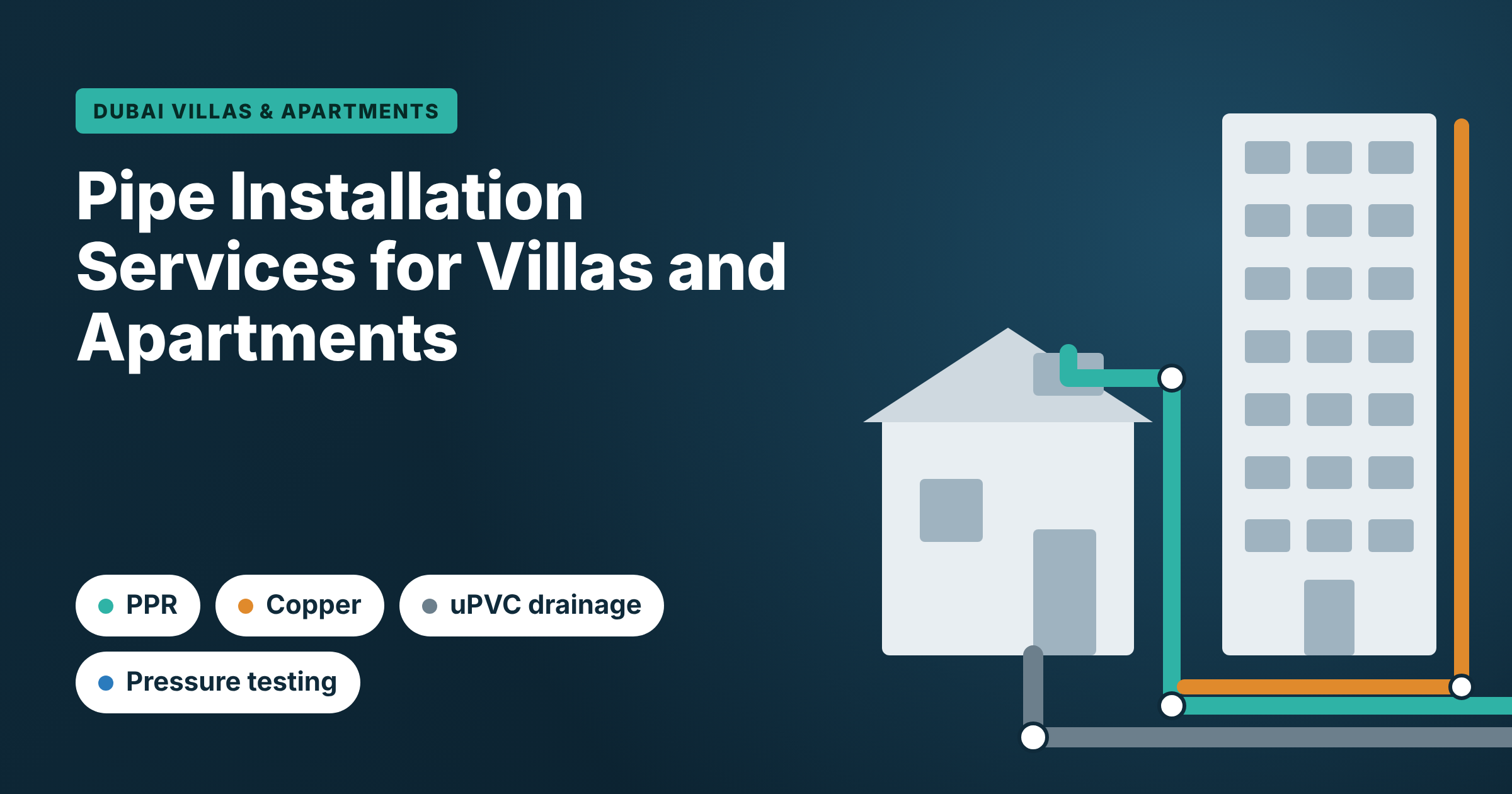
PPR (polypropylene random copolymer) is widely used for hot and cold water. Lengths are joined by heat fusion, so pipe and fitting become one piece with no glue or threads (Wavin Ekoplastik installation manual). Wavin lists “no corrosion or encrustation” among PPR’s advantages and quotes a service life of more than 50 years, subject to correct material selection and proper installation (Wavin PPR product guide).
Two points matter in Dubai. First, PPR expands as it heats. The Ekoplastik manual gives a coefficient of 0.12 mm per metre per °C for all-plastic PPR pipe and requires expansion to be handled through routing, loops and correctly placed fixed and sliding supports; multilayer (fibre- or aluminium-reinforced) PPR expands roughly a third as much. Second, sunlight harms it: Aquatherm, another PPR manufacturer, warns that prolonged UV exposure can discolour and weaken bare PPR, and recommends UV-protected pipe, insulation or a casing for exposed outdoor runs (Aquatherm). That includes villa roof lines from the tank.
Copper is the traditional metal option. It can be joined by soldering, brazing, flared fittings or press-connect fittings, and press-connect joints need no heat or open flame, which helps in occupied homes (Copper Development Association, Copper Tube Handbook). It is not weakened by sunlight the way bare plastics can be, but usually costs more than plastic pipe and needs skilled jointing.
CPVC is a chlorinated PVC rated for hot and cold water. The FlowGuard Gold system, for example, is specified for water service up to 180°F (about 82°C) and is joined with CPVC solvent cement (Charlotte Pipe).
PEX (cross-linked polyethylene) is flexible and needs fewer fittings, but it is sensitive to sunlight. The Plastics Pipe Institute’s installation guide says PEX should not be installed outdoors unless buried or properly protected from UV, and should not be stored where the sun reaches it (PPI PEX design guide).
Drainage pipes
uPVC is the usual material for soil and waste pipes. UAE manufacturer Cosmoplast, for example, makes uPVC drainage pipe to BS EN 1329-1 for soil and waste discharge inside buildings and to BS EN 1401-1 for underground drainage, joined with solvent cement and fitted with expansion couplers at suitable points (Cosmoplast uPVC drainage catalogue). Because drainage works by gravity, layout matters as much as material; UK building guidance, for instance, says pipes should be laid to even gradients (Approved Document H).
Material comparison
| Material | Typical use | How it is joined | Heat and sun | Points to weigh |
|---|---|---|---|---|
| PPR | Hot and cold supply | Heat fusion | Needs allowance for expansion; protect from UV outdoors | Does not corrode; needs fusion tools and trained installers |
| Copper | Hot and cold supply | Solder, braze, flare or press fittings | Not weakened by sunlight | Usually higher material cost; skilled jointing |
| CPVC | Hot and cold supply | Solvent cement | Rated for hot water within its limit | Check the product’s rating and local approval |
| PEX | Supply, mostly concealed | Manufacturer’s crimp or expansion fittings | Must be kept out of sunlight | Flexible, fewer joints; fittings are system-specific |
| uPVC | Soil and waste drainage | Solvent cement | Not a hot-water supply material | Layout and fall decide how well it drains |
We install supply pipework in PPR or copper. If a quote proposes a different material, ask why it suits your property and which product and approval it relies on.
Villas vs apartments: how pipe installation in Dubai differs
Villa communities
In villa communities such as Arabian Ranches, The Springs and The Meadows, Emirates Hills, Dubai Hills Estate and Palm Jumeirah, you normally control the whole system, from the meter to the last tap. That brings more to plan:
- Rooftop tank and booster pump. Many villas store water in a roof tank and use a pump to raise pressure. New pipework should be sized and routed with the pump in mind, and roof runs need UV protection or insulation.
- Longer runs and more risers. Water travels further between floors and wings, so sizing and isolation valve positions matter more.
- Outdoor and buried lines. Garden taps and external runs face sun and soil, which narrows the material choice. Irrigation is usually best kept as a separate circuit.
- Community rules. Master developers and community management set their own modification rules, and you may need a no-objection certificate (NOC) from them before work starts.
Apartment towers
In towers in areas such as Dubai Marina, JLT, Business Bay and Downtown Dubai, you own or rent a unit inside a shared building:
- Work stays inside the unit. The vertical risers and drainage stacks that serve several floors are shared building services; new pipework connects to them where the building allows.
- Building management sets the terms. Written permission and set working hours are usually required, and some buildings ask for more, such as contractor details or a deposit. Ask yours what applies.
- The neighbours below. A leak reaches the unit underneath, so isolation, testing and protection come first.
- Isolation valves. A good layout lets you shut off one bathroom or the kitchen without draining the whole flat.
The materials are the same in both; what changes is who controls the system and what a leak or a hot roof can damage.
If the re-piping is part of a wider refit, our guide to apartment renovation covers the rest of the process.
Approvals: whose permission you need
Requirements depend on your property and the scope of work, so confirm them with the relevant party before any wall is opened.
- Building management or owners’ association. Apartment works that affect shared services, noise or access normally need their written approval within set working hours. Check their process first.
- Master developer or community management. For villas and units in managed communities, you may be required to obtain a NOC from the master developer or community management (Khaleej Times). Each developer sets its own rules, so ask yours what applies to plumbing changes.
- Dubai Municipality. Interior changes and structural additions can need a Dubai Municipality modification permit (Dubizzle summary of the service). Whether pipe replacement alone triggers it is not clear from published guidance and may depend on the wider scope of works, so ask your contractor or developer to confirm for your job.
- DEWA. DEWA’s Water Network Modification service covers work such as shifting meters and water pipelines inside plots, and only enrolled consultants and contractors can submit it (DEWA). It concerns DEWA’s meter and network connection, not the pipes inside your home. If a contractor calls itself “DEWA-approved” for household plumbing, ask what that refers to.
How a proper pipe installation is done
Whether the job is one bathroom or a whole villa, the sequence is much the same.
- Survey and scope. The installer inspects the existing pipes, the water source (tank, pump or building supply), every wet area and the drainage connections, then agrees with you what is replaced and what stays.
- Layout and sizing. Routes are planned to keep runs short, put isolation valves where you can reach them, and allow for expansion and drainage fall. For concealed work, ask for a marked-up drawing.
- Isolate and drain down. Water is shut off at the right point, a villa’s main valve or the unit’s isolation valve in a tower, and the system is drained.
- Remove the old pipework and fit the new. Walls or floors are opened along the routes, old pipes are removed or capped, and new supply and drainage pipes are fixed with the correct supports.
- Decide concealed or exposed. Concealed pipes look tidier but mean chasing and re-tiling; exposed or boxed runs cost less and are easier to reach later. Either way, keep joints inside walls to a minimum.
- Pressure test before closing walls. This is the step to insist on. The supply pipework is filled and held under pressure while every joint is still visible, following the pipe manufacturer’s procedure for the system being installed. As one example, Wavin’s Ekoplastik PPR manual requires the system to be visible along its whole length, filled no sooner than an hour after the last weld and left for at least 12 hours, then tested at a minimum of 15 bar for 60 minutes with a maximum pressure drop of 0.2 bar, with the result recorded on a pressure test certificate. Other manufacturers set their own figures. Drainage should also be checked for leaks before it is boxed in; UK building guidance, for example, includes an air test for this.
- Flush and commission. New pipework is flushed before you use the water. BS EN 806-4, the European standard for installing drinking-water pipework inside buildings, covers filling and pressure testing, flushing and disinfection as part of commissioning (BSI).
- Reinstate and hand over. Walls and tiles are made good, fixtures are reconnected and checked for leaks, and you receive the test record and photos of the pipe routes before they were covered.
Keep those photos and the test record with your property documents; next time you drill a wall or chase a leak, you will know where the pipes run.
Where we fit in
Our plumbing services Dubai team replaces burst, corroded or scaled pipes in PPR or copper for villas and apartments, and handles renovation re-piping, including relocating supply and drainage. Re-piping is quoted after inspection, because the scope depends on what is behind your walls. For single-room projects, see our guides to bathroom plumbing installation and kitchen plumbing installation.
What drives the cost of pipe installation
No two properties need the same scope, so there is no honest flat price for re-piping. These factors move it:
- Size and number of wet areas. Each bathroom, kitchen, laundry and outdoor tap adds pipe, fittings and labour.
- Material. Copper usually costs more than plastic pipe and needs more skilled jointing.
- Concealed vs exposed. Chasing, re-plastering and re-tiling add to the pipework cost, and matching existing tiles is not always possible.
- Access and building rules. Limited working hours, lift bookings and floor protection in towers stretch the job over more days.
- Tank and pump work. Replacing roof lines, the tank connection or a booster pump in a villa adds scope.
- Permits and drawings. Approvals, NOCs or drawings the building or developer requires add time and sometimes fees.
How to judge a contractor’s quote
A useful quote shows exactly what you are paying for:
- Scope by area. Which rooms and which systems (hot, cold, drainage) are included, and where new pipework joins the old.
- Named materials. Pipe type, brand and pressure class, not just “pipes and fittings”.
- Concealed or exposed. Which runs go inside walls, and who pays for breaking, re-plastering and re-tiling.
- Testing. That supply pipes are pressure tested before walls are closed, by which method, and that you receive the record.
- Approvals. Who obtains building management or developer permission, and whether any DEWA or municipality step is involved.
- Exclusions. Tiles, sanitaryware, painting, heaters and pumps are often excluded.
- Handover. Photos of concealed routes, the test record, and any warranty terms in writing.
Also ask: What did the survey find? Where will the isolation valves go? How will you allow for expansion on the roof? What happens if the test fails?
Frequently asked questions
Can I replace GI pipes with PPR without changing everything?
You can replace a section, but the remaining corroded pipe can still send rust to your taps. If internal corrosion is the problem, replacing the whole run from the tank or main valve gives the cleaner result; a survey will show how far the GI pipework goes.
Is PPR or copper better for a Dubai villa?
Both work when installed properly. PPR does not corrode and usually costs less, but needs room for expansion and sun protection on roofs; copper is not weakened by sunlight and can be press-jointed without flame, at a higher material cost. Ask your installer to justify the choice for each part of the system, especially exposed roof and garden runs.
Do I need permission to change pipes in my apartment?
Usually, yes. Building management or the owners’ association normally approves works affecting shared services, noise or access and sets working hours, so check with them before booking. DEWA’s Water Network Modification service covers meters and network pipelines, not the pipes inside your unit.
Should water pipes be tested before the walls are closed?
Yes. Testing while every joint is visible lets a weak joint be fixed without breaking new tiles. Ask for the method, duration and a written record.
Can new pipework fix low water pressure?
Only if the old pipes are the cause, such as corroded GI pipes narrowed by rust. If the loss comes from the pump, a valve or the building supply, new pipes alone will not fix it.
Plan your re-piping
Decide which areas need new pipework, then agree the materials, approvals and pressure test in writing before anyone opens a wall. When you are ready, our plumbing services Dubai team covers villas and towers across the city; see the areas we cover, call or WhatsApp +971 55 355 8644, or get a quote. Quotes are free.