Kitchen Equipment Maintenance Services in UAE – Repair, Installation & Servicing
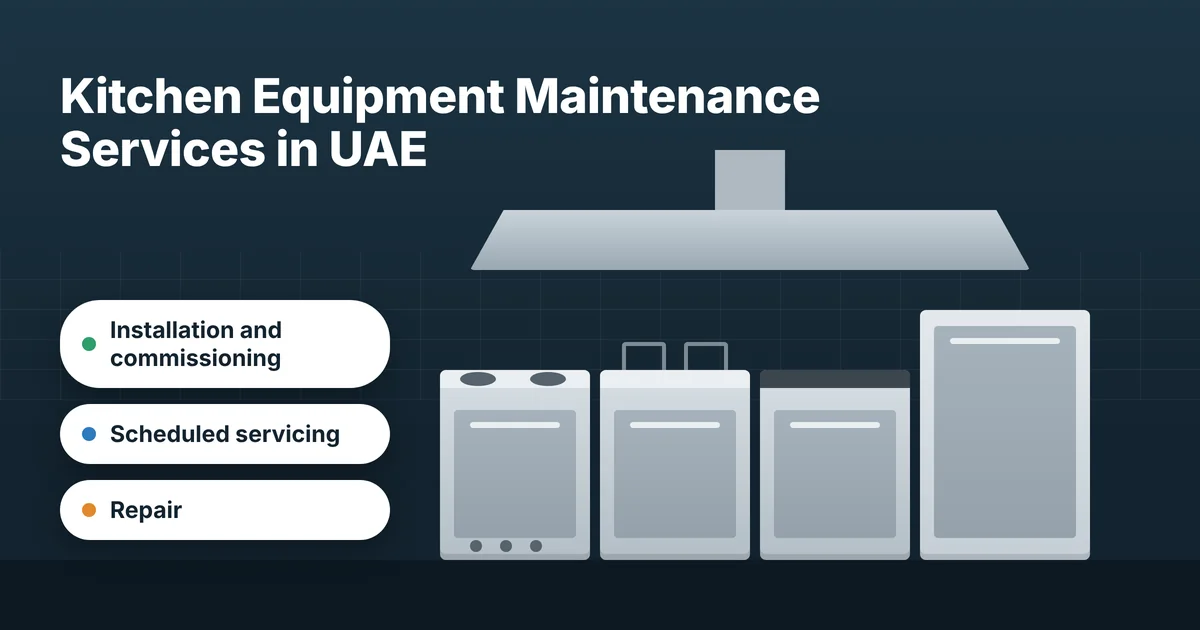
Over the course of its equipment’s life, a commercial kitchen requires three types of assistance. A new refrigerator, dishwasher, or stove is connected and operates securely during installation. It continues to function in between malfunctions thanks to scheduled maintenance. When anything breaks in the middle of service, repair restores it. All three are covered under commercial kitchen equipment maintenance, but each is scheduled differently, performed by separate individuals, and evaluated according to various criteria.
Owners, managers, head chefs, and facilities leads of Dubai’s restaurants, cafés, hotel kitchens, bakeries, and cloud kitchens are the target audience for this handbook. It outlines what should be included in each service, who should perform it, and what questions to ask before making a reservation.
The three services at a glance
| Service | What it covers | Who usually does it | When you need it |
|---|---|---|---|
| Installation and commissioning | Site readiness, placement, gas, power, water and drain connections, test run, staff handover | Equipment supplier or manufacturer-authorised installer, with an approved gas installer for gas lines and an electrician and plumber for site prep | New kitchen, new or relocated equipment |
| Scheduled servicing | Planned technician checks and cleaning that daily staff care cannot reach: coils, calibration, burners, filtration, scale | A maintenance provider on planned visits, under a contract or booked per visit | Throughout the equipment’s working life |
| Repair | Diagnosing and fixing a fault, replacing parts, confirming the unit works safely afterwards | A repair technician, ideally one with access to the right parts | When something stops working or behaves unsafely |
Which equipment this applies to
Most commercial kitchens run some mix of five equipment groups:
- Cooking equipment: ranges, ovens, combi ovens, fryers, grills and charbroilers.
- Refrigeration: reach-in fridges and freezers, under-counter units, and walk-in cold rooms.
- Warewashing: under-counter, hood-type and conveyor dishwashers.
- Extraction: canopy hoods, grease filters, ductwork and exhaust fans.
- Stainless steel work: tables, sinks, shelving and custom-fabricated pieces.
A refrigeration technician and a gas cooking technician are not always the same person, so ask a provider which of these groups it services in-house.
Installation and commissioning: getting the site ready first
Installation requirements are in each unit’s manual. If the site does not meet them before delivery, the unit waits disconnected or gets installed around the problem.
Site readiness checklist
Before delivery day, check each point against the manual for every unit you are buying. The manufacturer examples below show what to look for; your model’s figures may differ.
Power supply. Check the spec sheet’s voltage, phase, and current ratings against what the kitchen’s board is capable of providing. Certain devices require their own circuit. For instance, according to True’s refrigeration handbook, the cabinet “should always be plugged into its own individual dedicated electrical circuit,” and the circuit and outlet must be properly grounded by a certified electrician. In addition to requesting an accessible all-pole disconnecting device, Rational’s combi oven handbook instructs installers to adhere to local laws regarding fuses and residual current devices.
Gas supply. Rational’s installation instruction says, “The gas connection may only be made by a locally approved gas installer.” It also says that a leak check must be done using the right detector. Garland’s range manual says all fittings and pipe connections must be leak-tested, never with an open flame. Approval rules for gas work differ by site and authority, so ask your fit-out consultant or building management which approvals your gas contractor needs before work starts.
Water and drain. Combi ovens, steamers, dishwashers and ice machines need a water supply, and many need water of a particular quality. Rational, for instance, sets limits on supply pressure, chlorine and chloride, and requires a water filter if they are exceeded. The same manual asks for a separate wastewater connection for each unit and a grease separator on site. Dubai Municipality’s Food Code also expects grease traps to be “of a suitable type and be regularly inspected.”
Ventilation and hood. Cooking equipment has to sit under extraction sized and positioned for it. Rational’s manual specifies how far the hood should extend past the front of the oven, with a grease filter in that overhang, and says to keep the extraction running during gas operation.
Floor, space and clearances. Take the clearances from your own handbook as they are specific to each vehicle. For instance, Rational’s handbook prohibits placing fryers or other heat sources behind its combi oven and specifies that there must be a minimum of 350 mm between the left side of the oven and any heat source. Depending on the range model, Garland offers varying minimum clearances from flammable building. According to Dubai’s Food Code, heavy equipment must be positioned so that workers can access the area for cleaning, or it must be equipped with wheels.
Placement, connection and test run
Once the site is ready, the installer positions and levels the unit, connects it and runs it. Read each manual’s start-up section for first-use steps that are easy to miss:
- Refrigeration may need to settle. True’s manual tells owners to leave its cabinets upright for 24 hours before plugging them in. Other brands may differ, so check your model’s manual before switching on a newly delivered unit.
- Combi ovens may have a first-start routine. Rational’s manual lists steps before first use: remove all packaging and combustible materials from the cooking cabinet, update the software, and run the self-test. For its gas units, an authorised technician must also carry out a flue gas analysis before commissioning.
- Fryers may need a boil-out. Frymaster’s manual says a new frypot should be boiled out before first use.
Test under real conditions, not just power-on: cook, chill or wash, watch it reach temperature, check every connection for leaks, and make sure the extraction pulls correctly with the equipment running.
Handover: training and documents
Request that the installer guide your team through cleaning, shutdown, daily operation, and any error warnings. Rational requests that installers give the owner the manual and retain the manuals with the unit. Manuals, warranty documents, serial numbers, commissioning results, and installation contact information should all be kept in one location, regardless of the brand. They will be required for every subsequent service and repair appointment.
Scheduled servicing: what a preventive visit should check
Scheduled servicing has two layers: what your staff do every day, and what a technician does on a planned visit. A servicing contract does not replace the first.
Daily care by your team
A large portion of routine maintenance is left to the operator by manufacturers. For instance, the Frymaster fryer handbook instructs users to empty the crumb tray every day, clean the built-in filtering system every day, and filter the oil and clean the fryer during shutdown. Refrigerator door gaskets are “a housekeeping item requiring regular cleaning by the operator,” according to ENERGY STAR, which also cautions that harsh chemicals like incorrectly diluted bleach damage their lifespan. A documented cleaning schedule outlining what is cleaned, how frequently, by whom, and who checks it is also required by Dubai’s Food Code.
Skip the daily layer and a technician’s visit becomes a deep clean instead of a mechanical check.
Technician tasks by equipment class
A planned visit should reach the parts and adjustments staff cannot. The checks below draw on manufacturer and ENERGY STAR guidance. A manufacturer’s frequency applies to that brand’s equipment; take your own schedule from your units’ manuals.
Refrigeration (reach-ins, under-counters, cold rooms). The system has to work harder when the condenser coils are dirty. According to True’s handbook for its own cabinets, the condenser coil needs to be cleaned “every 30 days or as needed,” and if owners are unable to get rid of the dirt, they should contact a certified refrigeration service provider. Cleaning the condenser and evaporator coils, draining the drain, modifying hardware, and calibrating thermostats and timers are all included in the ENERGY STAR recommendations for reach-ins and under-counters. It adds mechanical and electrical testing for walk-ins.
Cooking equipment (ranges, ovens, grills). On gas equipment, the visit should cover burners and ignition. Garland’s manual says burners should periodically be removed and cleaned, blocked ports cleared, and pilots adjusted so burners light quickly. The technician should also check gas connections for leaks and confirm that controls and thermostats hold temperature.
Combi ovens. Planned visits should check the water treatment and drain the manual specifies. Rational’s manual recommends servicing only by technicians the manufacturer has authorised, so ask whether your provider is.
Fryers. A factory-approved servicer must inspect Frymaster’s fryers at least once a year, according to the manufacturer’s handbook; see your specific fryer’s handbook for details. Parts that employees shouldn’t touch, like the high-limit controls that stop power if the temperature control fails, are covered by that inspection.
Dishwashers. Hobart explains that hard-water scale makes pumps work harder and can affect sensors and valves. It recommends deliming “at the appropriate frequency, using the right delimer and dose,” and warns that too much deliming or the wrong procedure can damage the machine. A water softener reduces scale, so a servicing visit should check the softener and the deliming routine. If the machine is already failing, see our guide to commercial dishwasher repair.
Extraction (hoods, filters, ducts, fans). Ductwork and fans behind the grease filters need specialist attention. The US fire standard NFPA 96, a common international reference, ties inspection frequency to cooking volume: quarterly for high-volume operations such as 24-hour kitchens, charbroiling and wok cooking, and more often for solid-fuel cooking. In Dubai, the Food Code says ventilation systems should be cleaned according to the requirements of the concerned department. Confirm the current requirements for your premises rather than relying on an overseas schedule.
Stainless steel work. Check for loose fixings, failed welds, damaged sink fittings and leaks at connected plumbing. Dubai’s Food Code expects food contact surfaces and equipment to be kept “in a good state of repair and working condition.”
At Al Ghubaiba Technical Services, our kitchen equipment maintenance work covers repair and preventive servicing in Dubai for cooking ranges and ovens, fryers and grills, refrigeration and cold rooms, exhaust hoods and ventilation, and stainless steel fabrication. We do not supply kitchen equipment, so for a new installation, have the equipment installed and commissioned by its supplier or an authorised installer. We can help with site preparation: our team handles kitchen plumbing installation and dedicated appliance circuits. Tell us your site’s requirements and we will confirm what we can take on.
AMC or on-call: two ways to buy servicing
An annual maintenance contract (AMC) schedules visits in advance for an agreed scope; on-call servicing means booking a visit when you need one. The choice depends on how much equipment you run, what a breakdown costs you, and whether anyone tracks service dates.
Either way, get the terms in writing. Before you sign or book, ask:
- What exactly is covered? List the equipment by type, ideally by serial number, so nothing falls between contracts.
- How many planned visits, and what happens on each? Ask for the checklist for each equipment group, not just the number of visits.
- What is the response commitment for breakdowns? Get the stated time in writing, and ask whether it changes at night, at weekends or during Ramadan hours.
- How are parts and labour handled? Find out whether parts are included, discounted or charged separately, and who sources them.
- What do you get after each visit? Expect at least a written report of what was checked, what was found and what is recommended.
- What happens to manufacturer warranties? Some manufacturers require authorised servicers; Frymaster’s manual, for example, says unqualified service personnel will void the warranty. Check whether the provider is authorised for brands still under warranty, or plan warranty work separately.
Repair: when to call and how to prepare
Call for repair when a unit stops holding temperature, will not start, trips its safety controls, leaks, or puts food or staff at risk. Our guide to restaurant equipment repair covers the warning signs and common faults by equipment type.
Make the call safely
If you smell gas, Abu Dhabi’s Department of Energy advises: do not switch electrical devices on or off, close the gas valve, and call 997, the UAE fire and civil defence emergency number. Its guidance also says never to use a flame to check for a leak. Move people away from the area and let your gas supplier know as well.
For electrical faults, burning smells or tripping breakers, switch the unit off at its isolator if it is safe to reach; if not, wait for help. Do not remove panels or bypass safety controls to keep a unit running through service.
Information to have ready
Share these when you book so the technician can bring the right parts:
- Make, model and serial number from the unit’s data plate.
- The symptom in plain words, such as “not cooling below 10°C” or “burner lights then goes out.”
- Any error code or message on the display, ideally with a photo.
- When it started and what changed around then, such as a power cut, a deep clean, a moved unit or a new gas cylinder.
- Service history, including the last service report and any recent repairs.
Keep a maintenance record for every unit
Dubai Municipality’s Food Code (2013 edition) expects food establishments to make and keep records of the actions they take under their food safety programme. Its annex lists calibration records for equipment and measuring devices, and the grease trap cleaning contract, among the documents a food establishment holds. It also says monitoring devices should be calibrated at a pre-determined interval.
A binder or shared spreadsheet works. For each unit, record:
- make, model, serial number and installation date;
- warranty terms and expiry;
- every service visit and repair, with the date, provider, work done and parts replaced;
- calibration results for thermometers and temperature controls;
- the service reports themselves.
How to choose commercial kitchen equipment maintenance services
You can check most of what matters before you sign:
- Scope fit: the provider services the equipment groups you actually run.
- Visit reports: ask for a sample report.
- Parts access: ask how they source parts for your main brands and how long they take.
- Written response terms: the response commitment is stated in writing.
- Insurance and licensing: ask for proof of the licences and insurance your landlord, mall or hotel operator requires.
- Gas competence: anyone working on gas lines or connections holds the approvals that work requires.
Frequently asked questions
Who should connect a gas range or combi oven in a Dubai kitchen?
A gas installer approved for that work, as Rational’s manual requires for its gas units, followed by a leak check. Ask your fit-out consultant or building management which approvals apply to your site.
Can staff do some of the maintenance themselves?
Yes. Daily fryer filtering and gasket cleaning are operator tasks. Leave adjustments, gas, electrical and refrigerant work, and safety controls to qualified technicians; True’s manual says all servicing must be done by one.
Can a new fridge be switched on as soon as it arrives?
Not always. True’s manual asks for its cabinets to stand upright for 24 hours before they are plugged in. Check your own model’s manual for its start-up instructions.
Do combi ovens and dishwashers need water treatment?
Often, yes. Rational requires a filter when chlorine or chloride in the supply exceeds its limits, and Hobart notes that a water softener reduces dishwasher scale.
Will using a non-authorised technician affect my warranty?
It can. Frymaster’s manual says unqualified service personnel void the warranty, and Rational recommends only authorised technicians. Check your own warranty terms.
Does Al Ghubaiba install kitchen equipment?
We do not supply or commission kitchen equipment; that should come from the supplier or an authorised installer. We repair and service commercial kitchen equipment in Dubai and can help with site preparation such as plumbing connections, dedicated electrical circuits and stainless steel fabrication.
Book servicing or a repair visit
If you run a commercial kitchen in Dubai and want planned servicing, or need a unit looked at now, our licensed and insured technicians handle kitchen equipment maintenance and repair, with our workmanship guaranteed. Call or WhatsApp +971 55 355 8644 with the make, model and symptom, or request a free quote.